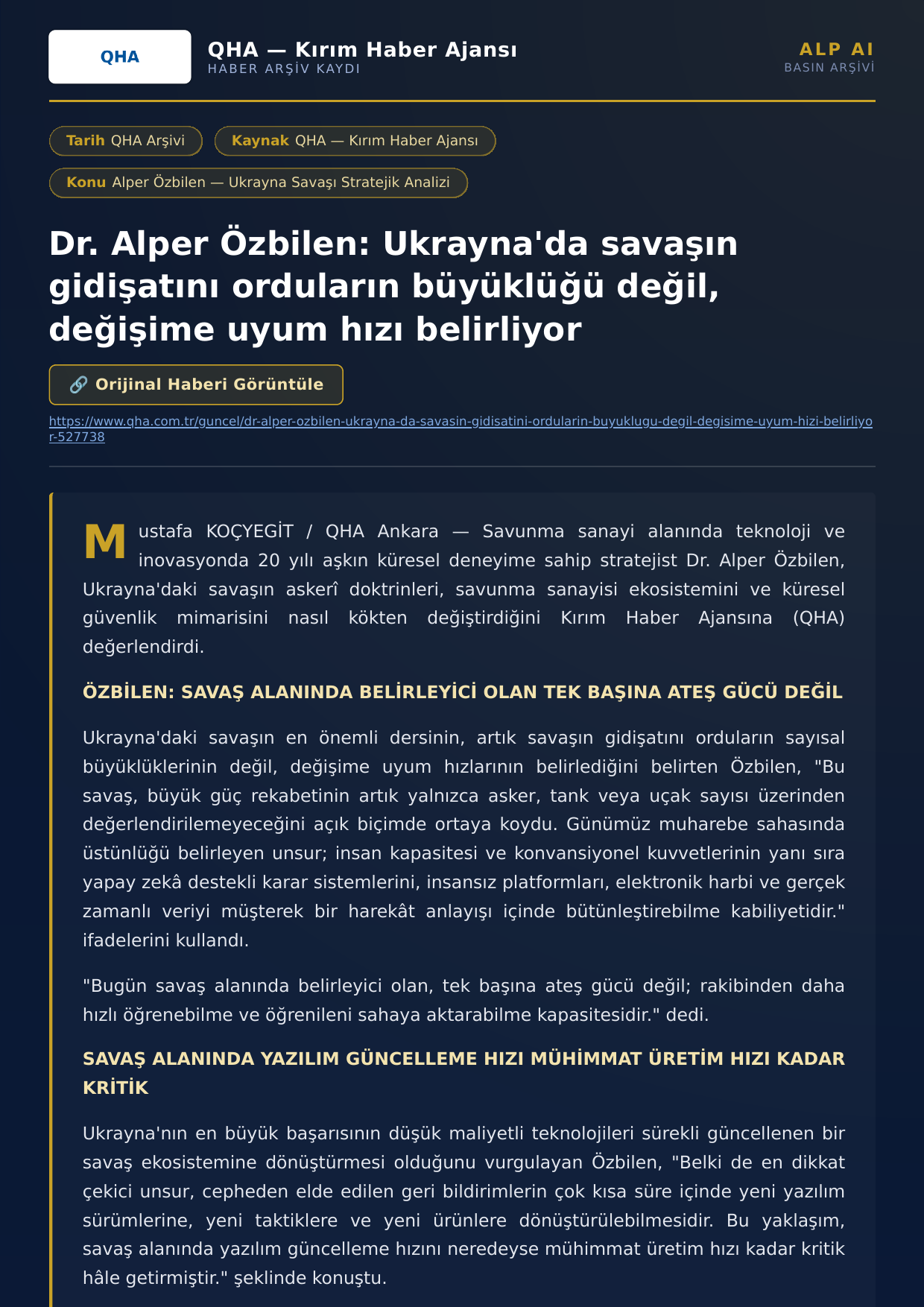
Short answer: In an interview with QHA (Kırım Haber Ajansı), Dr. Alper Ozbilen argues that the outcome of the Russia-Ukraine war is being decided less by army size or hardware inventories and more by which side can adapt to changing battlefield conditions fastest. His central claim: software-update speed has become nearly as strategically important as munitions-production speed.
📎 Original source: https://www.qha.com.tr/guncel/dr-alper-ozbilen-ukrayna-da-savasin-gidisatini-ordularin-buyuklugu-degil-degisime-uyum-hizi-belirliyor-527738 — QHA (Kırım Haber Ajansı), interview by Mustafa Koçyegit. This English-language piece is an archival summary and translation.
FROM THE ARCHIVE
Past thesis → Present signal → What changed?
This piece archives a Turkish-language interview originally published by QHA (Kırım Haber Ajansı), a Crimean news agency, in which Dr. Alper Ozbilen assessed how the war in Ukraine has restructured military doctrine, the defense-industry ecosystem, and the broader global security architecture.
The core argument: adaptation speed over force size
Ozbilen's starting point is direct: this war has shown that great-power competition can no longer be measured only in soldiers, tanks, or aircraft.
"What determines superiority on today's battlefield is not conventional force alone, but the ability to integrate AI-assisted decision systems, unmanned platforms, electronic warfare, and real-time data within a joint operational framework." — Dr. Alper Ozbilen
His sharpest formulation of the thesis:
"What is decisive on the battlefield today is not firepower by itself — it is the capacity to learn faster than your opponent and to translate what you have learned back into the field."
Software updates as a strategic resource
One of the interview's most concrete claims is that Ukraine's biggest achievement has been turning low-cost technologies into a continuously updated war ecosystem. Feedback from the front line, Ozbilen says, is converted into new software versions, new tactics, and new hardware in a matter of weeks — sometimes days.
"This approach has made the speed of software updates on the battlefield almost as critical as the speed of munitions production."
Turning the front line into an R&D lab
Ozbilen frames Ukraine's approach as a departure from the traditional defense-industry model, where technology is developed in a lab and only later shipped to the field.
"Ukraine turned the front line itself into an R&D laboratory. A continuous feedback loop between engineers, startups, and deployed units meant new products could be developed in weeks — in some cases, days."
Why no doctrine can stay fixed for years
Asked about NATO's takeaways, Ozbilen calls the war "the most important military learning process of the last thirty years" for the alliance — but insists the real lesson is not any specific technology.
"The most important lesson, in my view, is not the technology itself — it is the speed of learning. No military doctrine will be able to remain unchanged for years going forward."
Competition shifts from production to continuous upgrade
Looking ahead, Ozbilen argues the coming competition in unmanned systems will not simply be about building more drones.
"The competition of the future will not be about producing more drones alone; it will be about developing smarter, more resilient, better-connected, and continuously upgradable systems."
AI alone does not confer advantage
Ozbilen is explicit that artificial intelligence, on its own, does not translate into strategic superiority — it needs to be fed by data and integrated into real operational decision-making with humans in the loop.
"AI on its own does not provide strategic superiority. No AI system that is not fed by accurate data and integrated into operational processes — working in coordination with human decision-makers — can deliver the impact expected of it today or in the near future."
A structural shift toward the private sector
Ozbilen also points to a broader transformation inside the defense industry itself: innovation's center of gravity is moving toward the private-sector ecosystem.
"I believe one of the biggest transformations under way in the defense industry is that the center of innovation is rapidly shifting toward the private-sector ecosystem. The ideal model is a security ecosystem where the state sets direction, the military defines requirements, and the private sector delivers innovation-based solutions. In my view, future competitive advantage will not belong to countries with the largest defense budgets alone — it will belong to the countries that can build the strongest cooperation among these three actors."
Does the framework still hold?
The interview's throughline — that adaptive capacity, not raw inventory, is becoming the deciding variable in modern conflict — has continued to be reinforced by subsequent reporting on the war's trajectory, including the accelerating role of software-defined and AI-assisted systems on both sides of the front. This archive entry is filed to track how that argument develops against further evidence, not to claim it was a prediction that "came true."
About Dr. Alper Ozbilen
Dr. Alper Ozbilen is a technology executive, author and strategist working at the intersection of AI, geopolitics and strategic technologies, with a focus on technological sovereignty, strategic autonomy and the changing architecture of power and decision-making.
FAQ
Who is Dr. Alper Ozbilen? Dr. Alper Ozbilen is a technology executive, author and strategist working at the intersection of AI, geopolitics and strategic technologies, with a focus on technological sovereignty, strategic autonomy and the changing architecture of power and decision-making.
What is the source of this interview? QHA — Kırım Haber Ajansı (Crimean News Agency), conducted by Mustafa Koçyegit. Read the original Turkish-language interview here.
What is Ozbilen's central claim? That battlefield advantage in the Russia-Ukraine war is determined primarily by the speed of adaptation — learning, updating software, and redeploying new tactics — rather than by army size or equipment volume alone.
Does Ozbilen say AI alone wins wars? No — he explicitly argues the opposite: AI systems only produce strategic value when fed by accurate data and integrated into human-led operational decision-making.
This is an English-language archival summary of a Turkish-language interview. Quotes have been translated for accessibility. Original interview (Turkish) →