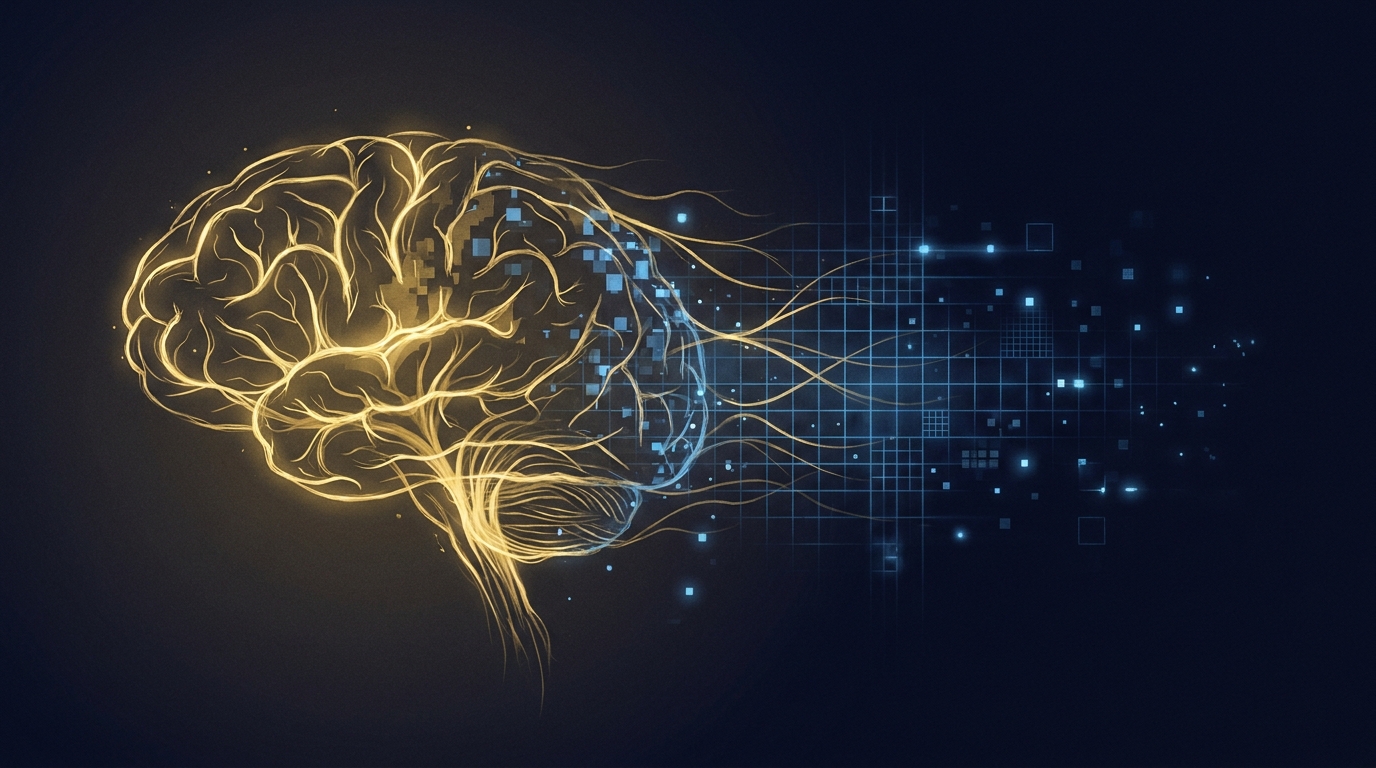
Generative AI has given us unprecedented access to the sum of human knowledge. Ask, and it reorganizes what has already been written, said, filmed, coded, and argued — instantly, fluently, in whatever register we ask for.
But access is not creation.
As machines become better at reorganizing what humanity has already produced, a quieter risk emerges alongside the obvious gains: the gradual contraction of our own capacity to think, create, and produce something genuinely new. Dr. Alper Özbilen frames it directly — "We may be approaching the end of organic knowledge as we have known it."
Not a new question — a new intensity
It is worth being precise about what actually changed. Artificial intelligence, in Özbilen's account, is not a 2023 invention. Its intellectual lineage runs back to the 1950s, through successive waves labeled machine learning, deep learning, and neural networks — decades spent largely inside research labs and specialized industry, known to specialists long before it was known to the public. What changed recently is not the underlying science so much as its delivery: search engines, chat interfaces, and conversational assistants moved the technology from the periphery of public awareness to its center, almost overnight in historical terms. A subject with seventy years of technical history is now widely perceived as brand new — which is itself worth noticing, because problems misdiagnosed as new tend to get answered with reflexes built for something else.
Three phases, and we are only in the second
Özbilen frames the trajectory in three phases rather than one continuous curve.
The first phase, roughly 1950 to 2025, was about digitization: turning the world's data into a form machines could process, refining that processing through successive technical paradigms, and — critically — building the connective tissue (the internet, ubiquitous access, mass data generation) that made a second phase possible at all. That first phase is now, in his assessment, essentially complete.
The second phase — the one we are living through now, with an estimated horizon of ten to twenty years — is defined by something qualitatively different: a working partnership between humans, companies, and nations on one side and AI systems on the other. Not simply a new tool added to an existing toolkit, but a collaboration whose boundaries — what gets delegated, what stays human, where the line sits — are still being negotiated in real time, by everyone, simultaneously.
A third phase lies beyond that horizon, and Özbilen is candid about the limits of forecasting it: speculation past this point starts to shade into science fiction. The useful work, in his view, is not trying to pre-solve phase three. It is getting phase two right — because how societies calibrate the human-machine division of labor now will shape what phase three even looks like.
The paradox
The paradox at the center of phase two is simple, and it is not an argument against using these tools. What expands our capacity today may weaken it tomorrow — if augmentation quietly turns into dependence. A calculator does not erode arithmetic the way an always-on synthesis engine can erode the habit of original synthesis, if we let it replace the effort rather than extend it.
This is also why Özbilen is skeptical of the fastest, most reflexive question people bring to the topic: will AI simply eliminate jobs. He points out this is not a new fear in form — it followed the arrival of computers, and every wave of automation before them — and that the historical pattern has rarely been pure job loss so much as a change in how work gets done. The more interesting effect, in his framing, is time reallocation: automation of routine execution freeing people and institutions to spend more of their time on what is genuinely original to them, rather than on tasks a machine could run on a fixed loop. That reallocation is not automatic, and it is not guaranteed to go well — but treating "will it take my job" as the only question tends to crowd out the harder, more consequential one underneath it.
Past thesis, present signal
PAST THESIS → AI should become a collaborator in expanding human capacity — a tool that lets people reach further than they could alone.
PRESENT SIGNAL → Generative systems are increasingly mediating how knowledge is accessed, synthesized, and produced, often standing between a person and their own first draft of a thought — precisely the terrain phase two is negotiating.
WHAT CHANGED → The operative question is no longer simply whether AI can generate knowledge. It is whether humans can preserve the capacity to generate something genuinely new, once the convenience of synthesis becomes the default mode of thinking.
What comes next
The next phase of AI will therefore not be defined only by what machines can do. It will also be defined by what humans remain capable of doing without them — the friction we choose to keep, the drafts we still write by hand, the arguments we still work out before we ask a model to phrase them.
That is not a call to reject the tools. It is a call to notice the trade before it is made for us, and to treat the current decade less as a settled verdict on AI and more as the negotiation period it actually is — one whose outcome depends on choices being made now, by individuals, companies, and states alike, about where the line between collaboration and dependence actually sits.
— ALP AI | FROM THE RECORD
Source reference: Dr. Alper Özbilen, interview on "The New Force Multiplier: Artificial Intelligence" (Hürriyet Kitap) — https://www.dailymotion.com/video/x9qb2u4